 |
 |
 |
 |
 |
 |
 |
 |
 |
 |
 |
 |
chinese-zodiac-symbols.com
Happy Chinese New Year, 2022 the Year of the Tiger!
Gong Xi Fa Cai 恭喜发财 -May You be Happy, May You be Wealthy in the New Year!
 虎年
虎年
FAQ (Frequently Asked Questions) for Chinese Zodiacs & Chinese New Year
Q1. What is the difference between the Chinese and Western Calendar?
The Western calendar (the Gregorian Calendar) is a Solar calendar based on the earth turning around the sun.
Chinese calendar is primarily a Lunar calendar based on the moon turning around the earth. It's actually a Lunisolar Calendar. Unlike the Greek or Islamic Lunar calendar, the MONTHS in the Chinese calendar are based on the moon ; but the YEAR in the Chinese calendar is based on the sun. It uses Intercalary months -- add one more month in an Intercalary year, then there were 13 months in this year. There are always either 29 or 30 days per month, no matter if it's an Intercalary month or not in the Chinese Calendar. To adjust the difference -- add 1 Intercalary month every 3 years, add 2 Intercalary months every 5 years, and add 7 Intercalary months every 19 years. It seems complicated but not if we remember that we also use Intercalary days in the Western calendar. That's the reason why in February there are 28 days but 29 days every fourth year. During a period of 400 years 97 (no 100) intercalary days would actually be added in total.
Chinese calendar uses the terms of the Heavenly Stems and Earthly Branches, and the combinations of 10 Heavenly Stems and 12 Earthly Branches to present the years, days and hours, e.g. Jia-Wu Year, Jia-Wu Day, Zi Hour etc.
10 Heavenly Stems are: 1. Jia 2. Yi 3. Bing 4. Ding 5. Wu* 6. Ji 7. Geng 8. Xin 9.Ren 10. Gei
12 Earthly Branches are: 1. Zi 2. Chou 3. Yin 4. Mao 5. Chen 6. Si 7. Wu* 8. Wei 9. Shen 10. You 11. Xu 12. Hai
*Wu is presented as 4 different Chinese characters at least because there are 4 tone marks for each syllable. There is no way to show 4 tone marks for each Chinese syllable in English so far. Therefore, at times it causes much confusion. Wu in 10 Heavenly Stems, Wu in 12 Earthly Branches, Wu in numbers (means 5) and Wu in Dr. Wu are 4 different Chinese characters.
For years: use only one Heavenly Stem plus one Earthly Branch, e.g. 2003 is Gei-Wei Year;
For months: uses numbers 1 to 12 like in Western calendar;
For dates and days: uses numbers 1 to 30 for dates and uses one Heavenly Stem plus one Earthly Branch for days, e.g. March 6 (date), Wu-Yin day; (There are No days like Monday to Sunday in Chinese calendar.)
For hours: uses 12 Earthly Branches to stand for 12 periods (called Shi-Chen) during 24 hours, each consisting of 2 hours.
Q2. Why are there 12 animals in Chinese zodiac symbols? Why is there no cat in Chinese zodiac symbols?
Many years ago, according to an Ancient Chinese legend, Buddha decided to choose animals as the signs of 12 year cycle. He summoned all the animals to be present at a meeting next morning and he would secretly select the first 12 animals arriving to be the signs of a year respectively. The rat and cat, who were good friends, agreed to wake each other up. Next morning Rat, who woke up first, broke his promise and left cat sound asleep as he quietly left alone to arrive at the meeting. Buddha selected the first 12 animals as they arrived to be the signs for the years. They came in this order: the rat, ox, tiger, rabbit, dragon, snake, horse, goat, monkey, rooster, dog, and the pig. By the time the cat arrived everyone was celebrating their good fortune and that is why there is no cat in the zodiac. Needless to say, Cat and Rat became enemies from then on.
Q3. How to be sure you have the correct animal year if you are born in January or February?
The New Year's Day in the Chinese calendar is in January OR February of the Western calendar depending on the year. If you are born in January or February, you may need to find the actual year in Chinese calendar.
The most important day is the Chinese New Year's Day (CNYD). For example, CNYD is Feb. 12 in 2002. 2001 is the Year of Snake while 2002 is the Year of Horse. You are a "Horse" if you are born in or After Feb. 12, 2002, but you are a "Snake" if you are born Before Feb. 12, 2002. Here are the CNYD for one hundred years -- Formats in "Year (CNYD-mm/dd)":
Example: 2003(02/01/) means CNYD is Feb. 1 in year of 2003.
1900(01/31), 1901(02/19), 1902(02/08), 1903(01/29), 1904(02/16),
1905(02/04), 1906(01/25), 1907(02/13), 1908(02/02), 1909(01/22),
1910(02/10), 1911(01/30), 1912(02/18), 1913(02/06), 1914(01/26),
1915(02/14), 1916(02/03), 1917(01/23), 1918(02/11), 1919(02/01),
1920(02/20), 1921(02/08), 1922(01/28), 1923(02/16), 1924(02/05),
1925(01/24), 1926(02/13), 1927(02/02), 1928(01/23), 1929(02/10),
1930(01/30), 1931(02/17), 1932(02/06), 1933(01/26), 1934(02/14),
1935(02/04), 1936(01/24), 1937(02/11), 1938(01/31), 1939(02/19),
1940(02/08), 1941(01/27), 1942(02/15), 1943(02/05), 1944(01/25),
1945(02/13), 1946(02/02), 1947(01/22), 1948(02/10), 1949(01/29),
1950(02/17), 1951(02/06), 1952(01/27), 1953(02/14), 1954(02/03),
1955(01/24), 1956(02/12), 1957(01/31), 1958(02/18), 1959(02/08),
1960(01/28), 1961(02/15), 1962(02/05), 1963(01/26), 1964(02/13),
1965(02/02), 1966(01/21), 1967(02/09), 1968(01/30), 1969(02/17),
1970(02/06), 1971(01/27), 1972(02/15), 1973(02/03), 1974(01/23),
1975(02/11), 1976(01/31), 1977(02/18), 1978(02/07), 1979(02/28),
1980(02/16), 1981(02/05), 1982(01/25), 1983(02/13), 1984(02/02),
1985(02/20), 1986(02/09), 1987(01/29), 1988(02/17), 1989(02/06),
1990(01/27), 1991(02/15), 1992(02/04), 1993(01/23), 1994(02/10),
1995(01/31), 1996(02/19), 1997(02/07), 1998(01/28), 1999(02/16),
2000(02/05), 2001(01/24), 2002(02/12), 2003(02/01), 2004(01/22),
2005(02/09), 2006(01/29), 2007(02/18), 2008(02/07), 2009(01/26),
2010(02/14), 2011(02/03), 2012(01/23), 2013(02/10), 2014(01/31);
2015(02/19), 2016(02/08), 2017(01/28), 2018(02/16), 2019(02/05).
2020(01/25), 2021(02/12), 2022(02/01), 2023(01/22), 2024(02/10).
If you can not find your year here, please E-mail Us. We'll e-mail you back.
Q4. What is the Chinese Zodiac Circle and the corresponding, and suitable animals in Chinese Zodiac Symbols?
The Chinese calendar is a combination of the 10 “Heavenly Stems”, Tian-Gan , and the 12 “Earthly Branches”, Dì-Zhi.
We don't want to confuse you with complicated astrology. Just show you where the Animals are SUIATED and how easy they are to remember:
Chinese Zodiac Circle(Click for large picture)
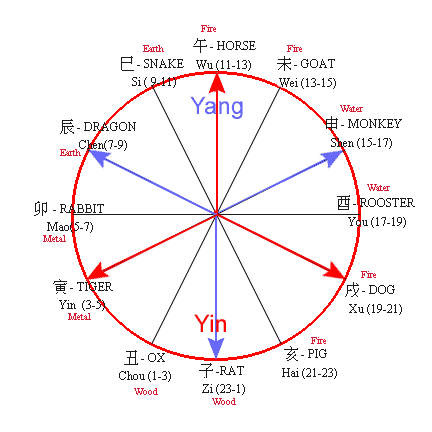
(Copyright by Chinese-Zodiac-Symbols.com. You are welcome to copy or reprint only if mentioning the source.)
Explanation: There are 12 periods (called Shi-Chen) during 24 hours in the Traditional Chinese Zodiac, each consisting of 2 hours. Each animal symbol is related to one Shi-Chen period in order.
12 Shi-Chen and 12 animals are:
1. Zi (23:00 to 1:00, i.e. 11 pm to 1 am) and Rat;
2. Chou (1:00 to 3:00, i.e. 1 am to 3 am) and Ox;
3. Yin (3:00 to 5:00, i.e. 3 am to 5 am) and Tiger;
4. Mao (5:00 to 7:00, i.e. 5 am to 7 am) and Rabbit;
5. Chen (7:00 to 9:00, i.e. 7 am to 9 am) and Dragon;
6. Si (9:00 to 11:00, i.e. 9 am to 11 am) and Snake;
7. Wu (11:00 to 13:00, i.e. 11 am to 1 pm) and Horse;
8. Wei (13:00 to 15:00, i.e. 1 pm to 3 pm) and Goat;
9. Shen (15:00 to 17:00, i.e. 3 pm to 5 pm) and Monkey;
10. You (17:00 to 19:00, i.e. 5 pm to 7 pm) and Rooster;
11. Xu (19:00 to 21:00, i.e. 7 pm to 9 pm) and Dog;
12. Hai (21:00 to 23:00, i.e. 9 pm to 11 pm) and Pig.
During the 12 Shi-Chen, one side is more Yin (or more Yang) then its opposite side is more Yang (or more Yin). For example, the Zi period (midnight) is most Yin, the Wu period (noon) is most Yang. Yin and Yang are opposite.
Determining the Opposite (unsuitable) Animals:
An animal is rejected by the one on the right opposite site in the Zodiac Circle. Rat and Horse, Ox and Goat, Tiger and Monkey, Rabbit and Rooster, Dragon and Dog, Snake and Pig are all rejected each other.
Determining the Suitable Animals:
Select the 3 animals who are evenly spaced from one another in the Zodiac Circle. For example, Rat and Dragon and Monkey (tied by blue arrow line in the circle), Tiger and Horse and Dog(tied by red arrow line in the circle) are suitable one another, and so on.
Q5. How to calculate the years of each animal?
Any year plus or minus 12 or 12 Multiple (For example: 12, 24, 36, 48, 60, 72, 96 and so on.) is the year with the Same animal sign.
For example, 2002 is the Year of Horse, 2002-12 = 1990, 2002-24 =1978, 2002-36 = 1966, 2002-48 = 1954, 2002-60 = 1942, 2002-72 = 1930, 2002-96 = 1918, ... 2002, 1990, 1978, 1966, 1954, 1942, 1930, 1918 ... are all the Year of Horse.
Q6. Why is Jade the royal gemstone in China?
Jade is the extremely hard stone (6.5 to 7.0). It was a Royal Gemstone in China and Asia, used as the Emperor Seal in the Palace, as the totems and the Essence of Heaven and the Earth in eastern religion. Of all materials in the world of Chinese antiquities, jade best exemplifies the essential aspects of Chinese culture. It is used for both spiritual and ornamental purposes. It is the symbol of power and associated with heroes, the symbols of pure, noble and sublime, and stands for morality. It is also a symbol of ethics and norms. In ancient times, only aristocrats could own jade wares. The imperial seal of the Qin dynasty, the first feudal society in China, was made of jade.
Jade has been the symbol of love and virtue for thousands of years in China. It was used for ritual utensil, funeral utensils, accessories, currency, weapons, diplomatic gifts, musical instruments (since the sound is pleasing to the ear and travels far) and food containers. It was not just a piece of jewelry, it was a part of one's being -- a gentleman would never discard his jade ornaments in Chinese culture.
Chinese people believed that jade ornaments could resist invasion of evil influence and create safety. The Taoists believed jade could keep one immortal physically. Jade carvings are used as amulets to protect people from disease and calm their emotions with spirituality in Buddhism.
Confucius even concluded jade had many virtues, namely benevolence, fidelity, courtesy, etiquette, wisdom and sincerity, etc. Yu means jade and Di means king in Chinese, then Yu-Di means the King of Heaven.
Copyright by Longherb Health Products (LHP), USA. You are welcome to copy or reprint only if mentioning the source of Chinese-Zodiac-Symbols.com
